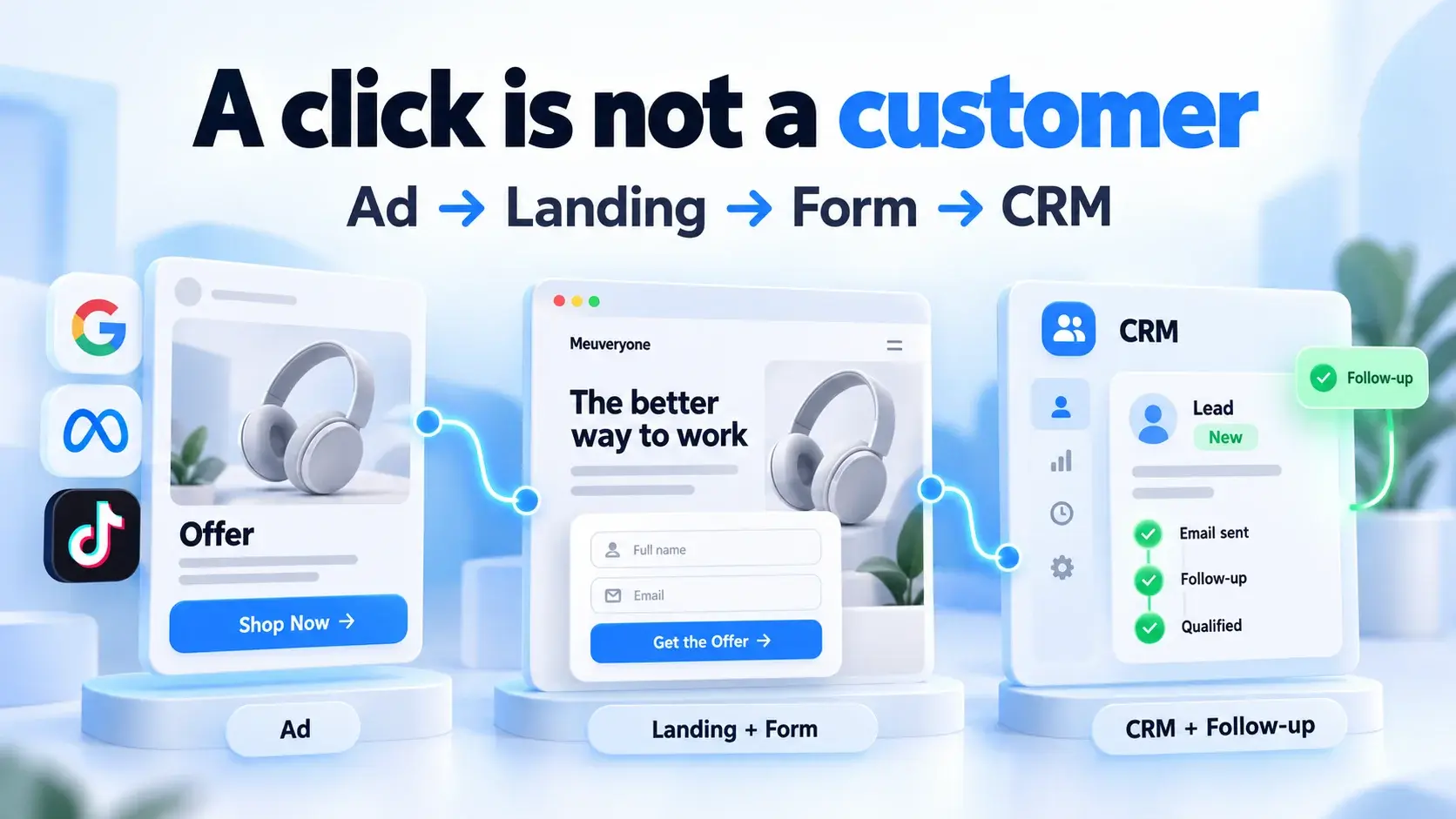
Meta, Google and TikTok can buy attention. The enquiry is lost when the landing page, form and follow-up do not keep the same context. How to connect the three before raising spend.
SOURCE CHECK
Reviewed September 28, 2026. This is an editorial framework for connecting paid campaigns, landing pages and CRM follow-up. It does not report performance from a Meuveryone client account.
Platform interfaces, attribution windows and automation defaults change during the year. Confirm the current settings inside each ad account before you copy a tactic from this page.
Google documents landing page experience as part of how Search ads are evaluated. That is a platform rule, not a Meuveryone result.
No revenue, return on ad spend or lead volume is claimed or guaranteed.
The click is only the middle of the job
A campaign can do one thing well: put a message in front of a person who might care.
What happens next is a different system. The landing page has to continue the same offer. The form has to ask for the information the sales conversation will need. The CRM has to show who should answer, with what context, and by when.
When those three pieces are separate, the report looks busy and the calendar stays empty. Clicks rise. Conversations do not.
This is common in small and mid-size teams that buy ads before they define the next step. It is also fixable without a larger media budget.
Three breaks that waste paid traffic
1. The ad promise is not the page promise
The ad mentions a specific service, price range or appointment. The landing page opens with a generic brand story. The visitor has to hunt for the thing they already clicked.
That extra search is unpaid work you just bought.
A useful check is blunt: cover the logo and read the first screen. If a person who saw only the ad cannot tell that they arrived in the right place, the page is not doing campaign work. It is doing brochure work.
Google’s own landing page guidance points in the same direction: the page should be relevant to the query or the ad, useful, and easy to act on. Relevance here is editorial, not decorative.
2. The form collects a name and deletes the context
A form that asks for name, email and “message” looks complete. In the inbox it is not.
The team then writes back to ask which service the person wanted, which city they are in, or whether they already saw a price. Each extra question is a place where the enquiry can stop.
The minimum useful context is usually:
- which offer they came for
- how they prefer to be contacted
- a time window or urgency
- the campaign or page that sent them, captured automatically
That last field should not depend on the visitor typing UTM parameters. Hidden fields, a unique landing URL or a WhatsApp pre-filled message can carry the source without extra work for the customer.
3. The lead arrives with no owner and no next action
A notification in email is not a process. It is a hope that someone is looking at that inbox now.
A CRM foundation gives the enquiry a record, a responsible person and a first task. Without that, paid traffic ends in a shared mailbox and a delayed reply that no longer matches the ad the person remembers clicking.
Map the journey before you raise the budget
Write the path as four lines, not as a deck.
- Interest. The ad names one offer and one reason to click now.
- Arrival. The landing page repeats that offer above the fold and shows the next action.
- Enquiry. The form or WhatsApp message keeps the offer, the source and the preferred channel.
- Follow-up. Someone owns the record and the first reply has a purpose: confirm the need, book a call or send the exact document the page promised.
If any line is missing, spend is not the constraint. The constraint is the gap.
This is the same sequence used on Meuveryone’s campaigns work: discovery of the message, a landing page that can receive the click, and an enquiry that can be answered. Combined campaigns and CRM operations start from $750 per month. Standalone ad management is quoted separately. Media spend, licences and tools sit outside that figure.
What to measure instead of vanity volume
Clicks tell you that the auction found someone. They do not tell you that your business can answer.
A tighter weekly review uses four numbers:
- clicks to the intended landing page, not to the homepage by default
- form starts versus form completions
- enquiries that arrived with offer and source attached
- first human response time for those enquiries
If the first number grows and the fourth does not move, buying more traffic will not help. Fix the page, the form or the ownership first.
Attribution inside Meta, Google or TikTok will still disagree with your CRM. That disagreement is expected. The CRM is the record of conversations. The ad platform is the record of auctions. Reconcile them on enquiries and booked next steps, not on every view-through claim.
Platform conversion tracking still matters so the auction can learn. It does not replace the record your team uses to answer. Keep both. Do not treat them as the same number.
A bounded way to start
Do not rebuild the whole funnel this week.
Pick one live campaign and one offer. Send it to one page. Give that page one form or WhatsApp route. Send every submission to one pipeline with one owner.
Run that shape long enough to see whether the reply happens. Then decide whether the message, the audience or the page needs work.
AI tools can draft ad variants and summarise replies. They cannot decide which offer is true, which lead is ready or who on your team should speak next. Those decisions stay with the business. Creative experiments — including motion work generated with AI — only help after this path exists.
Search visibility follows a similar rule: a page is useful when the person who arrives can act. That is the same discipline described in the September 2026 spam update note.
Frequently asked questions
Can I send campaign traffic to the homepage? You can. You will usually pay to make the visitor search again. A dedicated landing page is the clearer default when the ad names one offer.
Does CRM have to be GoHighLevel or Kommo? No. Those are examples we implement. The requirement is a record, an owner and a next step. The platform is chosen against the team’s tools and the proposal.
Is a WhatsApp button enough? It is enough only if the first message still carries the offer and the source, and if someone answers inside a defined window. A button without ownership is another notification.
Will connecting campaigns and CRM increase sales? It can remove a common place where interest dies. It does not create demand on its own and it does not guarantee sales.
Sources & editorial review
This article is Meuveryone’s working method for acquisition and follow-up. Platform documentation changes; verify current campaign types and attribution settings in each account.
We do not claim affiliation with Meta, Google or TikTok. Advertising spend is separate from service fees. No campaign results are guaranteed.
Buy attention only as fast as you can keep context. The click is useful when the page, the enquiry and the first reply still talk about the same offer.
Explore the related service ↗